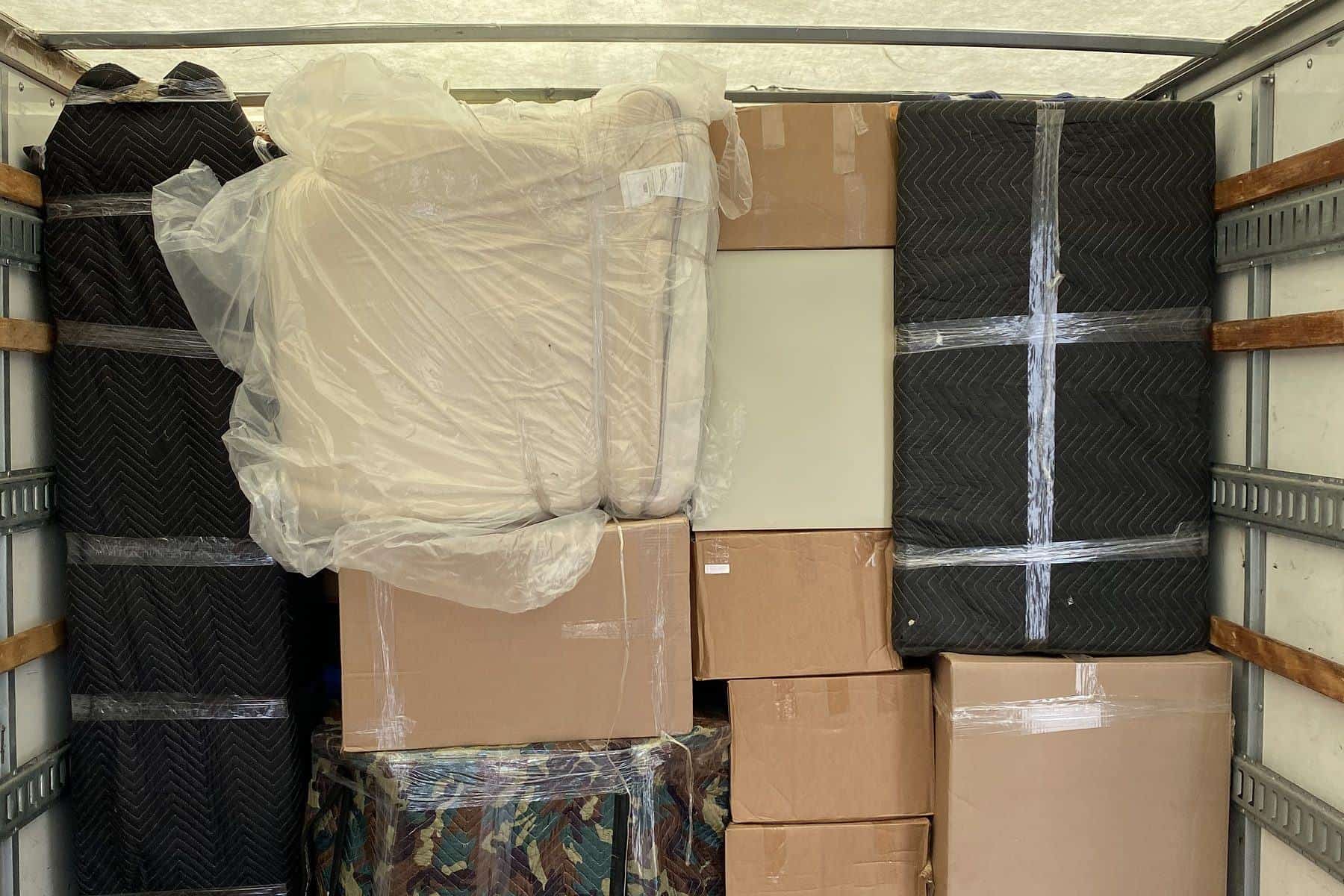

Packing badly costs you twice: once when something breaks, and once when the crew has to repack your boxes before they can safely load the truck. Neither is dramatic, but both are avoidable. This is how we pack, room by room, and what we would tell you to do if you are packing yourself.
What you actually need
Not everything sold as a “moving kit” is worth buying. What matters:
- Small boxes for anything heavy — books, tools, tinned food, records. Big boxes of heavy things get dropped.
- Medium boxes for the bulk of your possessions.
- Large boxes for light and bulky only: bedding, pillows, lampshades, cushions.
- China boxes (double-walled, with cell dividers) for dishes and glassware.
- Wardrobe boxes so hanging clothes go straight from rail to rail.
- Mattress covers — a bare mattress in a truck picks up everything the truck floor has.
- Packing paper rather than newspaper. Newsprint transfers onto china and glass.
- Bubble wrap, packing tape, and a marker.
Buy about a third more tape than you think you need. Running out of tape at 11 PM the night before is a rite of passage nobody enjoys.
The rules that apply to every box
Match the box size to the weight
A box should be liftable by one person without a change of grip. If it needs two people, it is too heavy and the bottom will eventually fail. Heavy things go in small boxes; light things go in large ones. This one rule prevents most box failures.
Fill every gap
Empty space is what breaks things — contents shift, then they collide. Fill voids with packing paper, towels or linen until the box does not rattle when you tilt it. A properly packed box is firm, not squashy.
Tape the bottom properly
Three strips: one along the seam, one on each side of it. On heavy boxes, add strips across the ends in an H pattern. Do not rely on interlocking flaps.
Label the side, not the top
You will be reading labels in a stack. Write the destination room — the room it is going to — and two or three words about the contents. Add FRAGILE and THIS WAY UP where they apply, on more than one face.
Kitchen
The kitchen takes the longest and breaks the most, so start here while you still have patience.
Plates go on edge, not stacked flat. Wrap each plate in paper, then stand them vertically in a china box like records in a crate. A plate on its edge survives a jolt that would crack a stack.
Glasses and stemware get paper stuffed inside the bowl first, then wrapped individually, then placed upright in the cell dividers. Never nest glasses inside each other.
Knives — wrap the blade in paper, tape it closed, and write KNIFE on the outside. Somebody has to unpack that box.
Small appliances travel best in their original boxes if you kept them. If not, remove detachable parts, wrap the cord, and pack the parts alongside in the same box.
Open liquids — oil, vinegar, sauces — either travel with you upright in a sealed crate or get thrown out. In a truck in summer they will find a way out of the bottle.
Living room
Books lie flat in small boxes, spine down if standing. Never spine up — the pages sag away from the binding.
Televisions should be boxed rather than blanket-wrapped where possible, and always transported upright. A flat screen laid flat can crack from its own flex over a long drive.
Photograph the back of every device before you unplug anything. It takes ten seconds and saves twenty minutes at the other end.
Lamps come apart: shade, bulb, harp, base. The shade goes in its own box with paper — never wrapped in newspaper, which marks the fabric — and the base is wrapped like any other fragile object.
Bedrooms
Hanging clothes go in wardrobe boxes. If you are not using them, take clothes off the rail in bunches of five or six, keep them on the hangers, and fold the whole bunch into a large box with the hangers together at one end.
Folded clothes can usually stay in the drawers if the dresser is solid and the drawers do not slide out — tell your crew, and they will wrap it as one piece. Do not do this with heavy items or with a flat-pack dresser.
Mattresses need a cover. This is not optional if the mattress is going in a truck with anything else.
Jewellery, cash and documents do not go on the truck at all. They travel with you.
Bathrooms
Seal every liquid: unscrew the cap, cover the opening with cling film, screw the cap back on over it. Then bag toiletries in a sealed plastic bag before they go in the box, so a leak is contained to the bag rather than the box.
Throw out the half-used bottles. You are paying to move volume, and you will not miss them.
Home office
Back up your computer before moving day. Every time. Drives fail when they are jolted.
Cables — coil each one, secure it, and label it with what it belongs to. A box of anonymous tangled cables is a box you will throw away in a year without ever opening.
Paperwork you cannot replace — deeds, passports, birth certificates, tax records — goes in your own bag, not on the truck.
Mirrors, artwork and glass
These are the items most likely to be damaged and the most commonly packed wrong. Tape an X across the face of a mirror or glazed picture — it will not stop a break, but it holds the pieces together if one happens. Then wrap in paper, then bubble wrap, then place in a picture box or between two sheets of cardboard taped together.
They travel on edge, upright, never flat, and never with anything stacked on them. Marble and stone tops are the same: on edge, crated, never flat.
This is the category where specialty handling pays for itself most often. It is what we soft-crate with cardboard as standard.
What we cannot transport
No mover can legally carry hazardous materials. That means paint, propane tanks, gasoline, lighter fluid, aerosols, pool chemicals, fireworks, ammunition and most solvents. Plants often do not survive a long move and are restricted crossing some state lines. Perishable food should be eaten or given away.
If you are not sure about something, ask before moving day rather than on it.
Pack an open-first box
One box, clearly marked, last onto the truck and first off. Toilet paper, hand soap, paper towels, bin bags, a box cutter, phone chargers, medication, a change of clothes, basic tools, bedding for the first night, and whatever you need to make coffee.
When it is worth paying someone
Packing yourself saves money and costs time — usually far more time than people estimate. A one-bedroom apartment is a couple of solid evenings. A three-bedroom house is a weekend at minimum, and that is if nothing else is happening. If you are packing yourself, start it at the point our moving checklist says to, not the week of the move.
The middle option is the one most people actually want: partial packing, where you handle the books, clothes and linens and we take the kitchen, glassware, mirrors, artwork and wardrobe boxes — the things that break when they are packed wrong. If you would rather hand over the whole job, full packing covers the entire home, including furniture disassembly and soft-crating for glass and marble.
Either way we arrive with the materials, so there is nothing to buy in advance.
Expedite Moving packs and moves out of Rahway, New Jersey; Brooklyn, New York; and Sunrise, Florida. Request a free quote or call 888-877-4425.