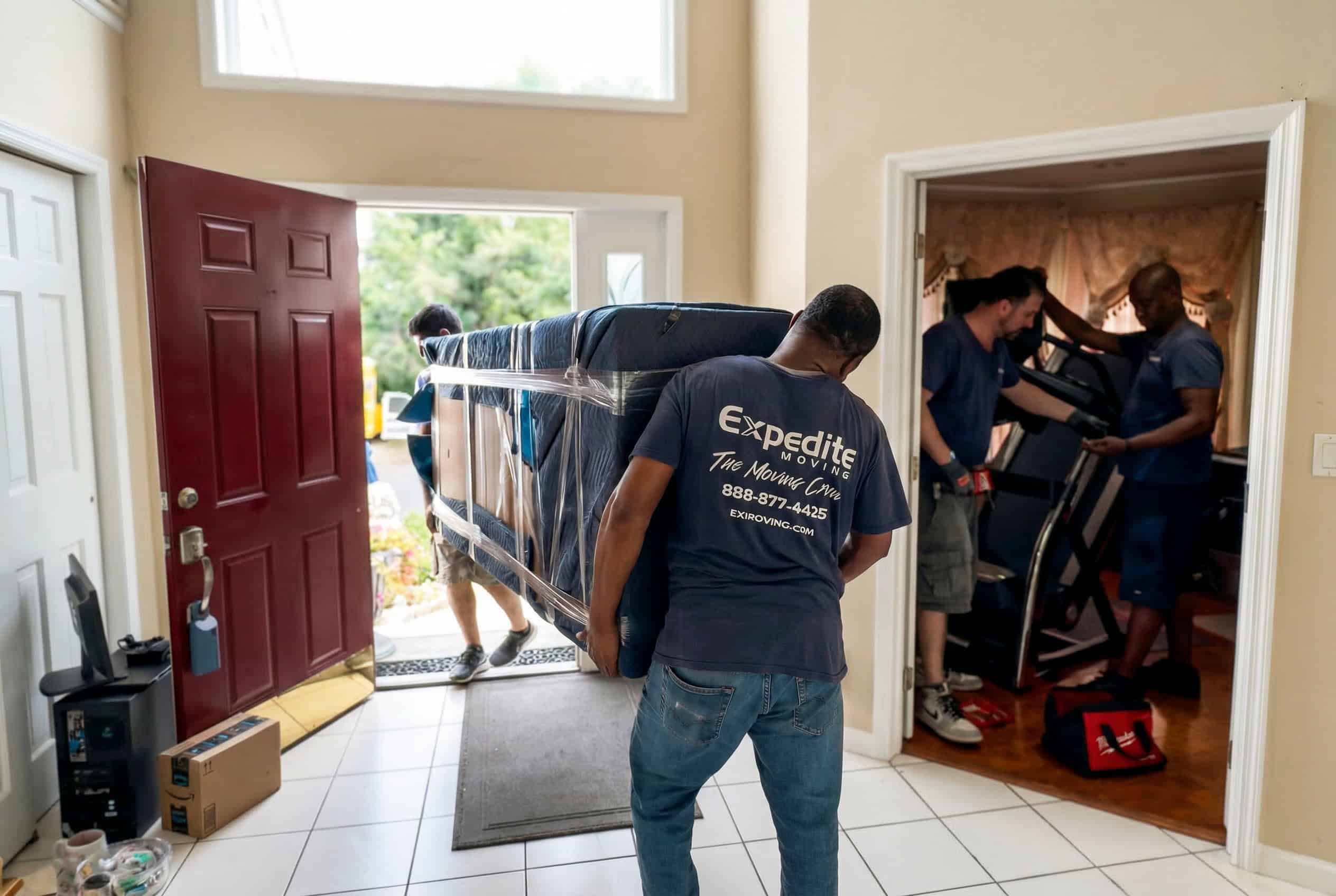

Most of the stress in a move comes from doing things in the wrong order. Booking the truck after you have started packing, discovering the building needs a certificate of insurance the day before, finding out on moving day that the lift has to be reserved a week in advance. None of those are hard problems — they are just problems you found too late.
Here is the order we would follow, based on what actually goes wrong on jobs we run out of New Jersey, New York and Florida.
Eight weeks out
Get quotes and book. Good crews get booked first, and the end of the month and the summer go fastest of all. If you are moving between May and September or on the last weekend of a month, eight weeks is not early — it is normal.
When you collect quotes, make sure each one is based on the same information: what is moving, and what the access is like at both ends. A quote given without asking about stairs, elevators or parking is not a quote, it is a placeholder.
Check your building’s rules. This is the single most common cause of a delayed move day. Many apartment buildings, co-ops and condo associations require:
- A reserved service elevator, often in a fixed time window
- A certificate of insurance from your mover, naming the building
- Moves only on weekdays, or only between certain hours
- A deposit against damage to common areas
Ask your building management for their move-in and move-out policy in writing now, and send it to your mover. We issue certificates of insurance as a matter of course — but we need a few days and the building’s exact requirements, not a phone call on the morning.
Six weeks out
Decide what is not coming with you. You pay to move volume. Anything you would not pay to transport is worth selling, donating or discarding now, while you still have weekends to deal with it.
Be realistic about furniture in particular. A sofa that will not fit up the stairwell of the new place is an expensive thing to discover on delivery day. If you have measurements for the new home, check the big pieces against the doorways and stair turns.
Start using up what you cannot move. Movers cannot transport hazardous materials — paint, propane, gasoline, aerosols, cleaning chemicals under pressure. Open bottles of anything are also a bad idea. Start running down the contents of the garage and the cleaning cupboard now rather than binning it all in a panic later.
Four weeks out
Confirm packing. If you are packing yourself, this is when to start, beginning with anything you will not need before the move: books, out-of-season clothes, decorations, the good china.
If you would rather not, decide now between partial and full packing. Partial packing means you handle the books, clothes and linens and the crew takes the kitchen, glassware, mirrors, artwork and wardrobe boxes. Full packing means the crew packs the entire home, including furniture disassembly, mattress covers, china boxes and soft-crating for glass and marble.
Deal with the address changes. USPS mail forwarding, bank, insurance, employer, driver’s licence, voter registration, and any subscription that ships you something physical. Doing this four weeks out means the first missed item arrives while you can still fix it.
Book anything specialist. Pianos, pool tables, safes, oversized artwork and anything needing a hoist have to be scheduled with the right crew and equipment. Tell your mover about these items now, not on the day.
Two weeks out
Confirm every detail in writing. Date, arrival window, address at both ends, crew size, what is being packed by whom, and the price. Re-confirm the elevator reservation with the building.
Arrange parking. In dense areas this matters more than almost anything else. A truck that cannot get within fifty feet of your door turns into a long carry, and a long carry costs time — which on a local move is money. Some cities let you reserve curb space or obtain a temporary permit; it is worth the phone call.
Plan for children and pets. Moving day is loud, the doors stand open, and there are strangers carrying heavy things through every room. Arranging for kids and animals to be somewhere else is safer and genuinely faster.
One week out
Finish your own packing. Label boxes by the room they are going to, not the room they came from, and write the contents on the side rather than the top — you will be reading them in a stack.
Photograph the backs of your electronics before anything is unplugged, and photograph any furniture that gets disassembled. Reassembly at the other end is much faster with a picture.
Set aside what travels with you. Jewellery, cash, passports and important documents should be in your own bag, not on the truck. Add medication, chargers, a change of clothes, basic tools and anything the children or the pets need for two days.
Defrost the freezer at least 24 hours ahead, and empty the fridge.
The day before
Pack an essentials box that is the last thing on the truck and the first thing off: toilet paper, hand soap, paper towels, bin bags, a box cutter, phone chargers, bedding for the first night, and coffee with a way to make it.
Clear a path. Move the small furniture out of hallways and doorways so the crew is not navigating obstacles with a wardrobe on a dolly.
Moving day
Be there, or have someone there who can make decisions. The crew will have questions — this piece or not, this room or that one — and a job where nobody can answer runs slow.
Walk the empty house before the truck leaves. Check every cupboard, the loft, the garage, behind doors, and the back of the wardrobe. Then walk the new place with the crew as things come off, and say where you want the big pieces before they are set down.
If you would rather not manage all of it
Most of this list exists because moving is a project, and projects need a schedule. If you would rather hand over the parts that need equipment and experience, that is what we do — local and long-distance moves, packing, and storage when the dates do not line up.
Expedite Moving works out of Rahway, New Jersey; Brooklyn, New York; and Sunrise, Florida, seven days a week from 7:00 AM to 9:00 PM. Request a free quote or call 888-877-4425 and we will tell you exactly what your move involves before you commit to anything.