
Local and long-distance moving across Summit, New Jersey (07901) — big pre-war houses, twelve historic districts and a citywide overnight parking ban, handled by our own crews out of Rahway. No brokers.
Summit is a town of large, old houses that were built before anyone owned a sectional sofa. Roughly a third of the housing stock predates 1940, three-quarters of it is three bedrooms or more, and the city is fully built out — 139 net new units in the fifteen years to 2023. Moving here is a question of getting big furniture through doorways, staircases and porches that were framed a century ago, on streets where a truck cannot be left overnight.
Summit has 8,603 housing units. Three-quarters of them — 74 percent — are single-family houses, and 6,335 of the total, 73.7 percent, have three bedrooms or more. That is the single most useful statistic on this page for planning a move: the typical Summit household is moving the contents of a large house, not an apartment.
About a third of those houses were built before 1940. The city has twelve historic districts; the North Side alone holds more than a hundred Tudor Revival houses, with Queen Anne, Shingle and Colonial Revival styles throughout, and the downtown district has been on the National Register since June 2011. In practice that means original hardwood floors that we protect from the front door inward, plaster walls that do not forgive a corner clipped on the turn, turned staircases with a landing halfway up, and the occasional piece of furniture that went in before a wall was moved and now has to come out through a window.
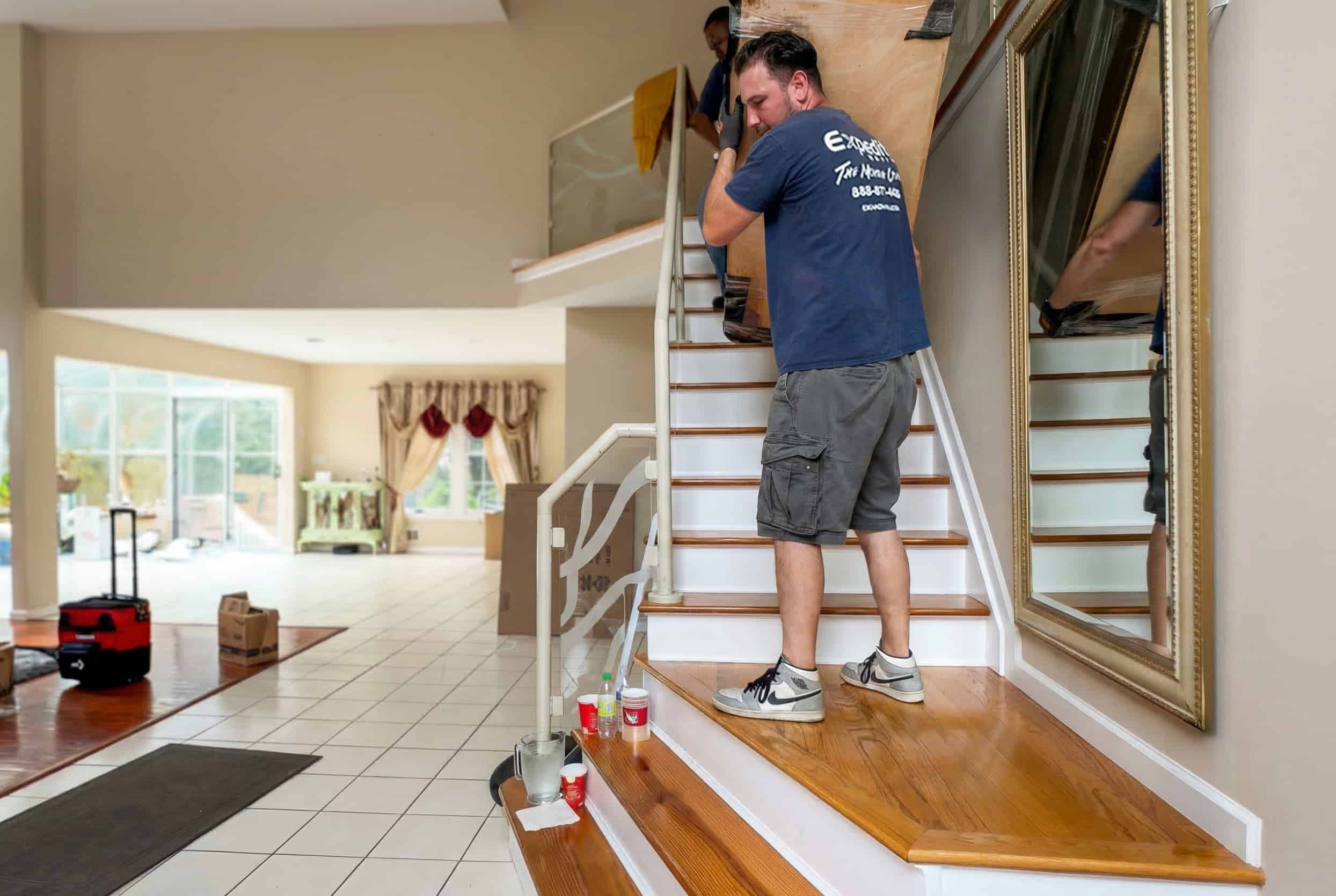
None of that is a problem — it is simply the work — but it changes the crew and the hours. A four-bedroom Tudor with a finished third floor is not a four-hour job, and a price that pretends it is will be a different price on the day.
Summit prohibits overnight street parking citywide between 2:30 and 5:00 a.m. That matters for one reason: we cannot stage a truck on your street the night before an early load. The truck arrives on the morning of the move, which is why we prefer a start time that leaves margin for the drive up from Rahway rather than an 8:00 a.m. curb-side commitment.
There is no moving-van permit in Summit's code — we checked. What the code does require is a permit from the Construction Official if a container or POD is going to obstruct the street (§18-4.1), with the obstruction limited to half the street width and a minimum fine of $75 (§18-6.2). That applies to storage containers left on the road, not to a truck loading at the curb. The city also designates truck routes for vehicles over four tons (§7-9A), with an express exception for pickup and delivery — so a moving truck serving an address on a restricted street is permitted. We have not yet confirmed the street-by-street list with the city and will not guess at it here; if your street looks like a through route, tell us and we will check before the day.
We have moved one Summit household so far, so what follows is what a move of each size takes rather than a long local track record. The pricing is the same everywhere we work.
| Home | Crew | Hours on site, typical | Packing |
|---|---|---|---|
| Two-bedroom condo or apartment | 3 movers, 1 truck | 4–5 | Self-packed or partial |
| Three-bedroom Colonial | 3–4 movers, 1 truck | 6–8 | Partial (kitchen, art, glass) |
| Four-bedroom Tudor, finished third floor | 4–5 movers, 1–2 trucks | 8–10, sometimes two days | Full pack the day before |
| Five-plus bedrooms, North Side | 5–6 movers, 2 trucks | Two days | Full pack, crated art |
The third-floor and attic rooms are what push a Summit job into a second day. Everything up there comes down a narrower staircase than the main one, one piece at a time.
Local moves are priced by the hour: $40 per mover per hour plus $75 for the truck. A three-person crew with a truck is $195 an hour, four is $235. We bill a three-hour minimum plus an hour of travel, which puts the practical floor at about $800.
Across all our local work the median is about $1,265. Summit will usually land above that median, because the houses are large and old — a four-bedroom with a full pack is a two-crew, two-truck job. We put the estimate in writing before the day, and on a house of this size we would rather come and walk it than quote from a bedroom count. A binding estimate is available on request; read our guide to binding versus non-binding estimates if you want to know exactly what that locks in.
Summit is a city of 22,719 people in 8,341 households, with a median household income of $190,304 and a median home value of $994,500. Just over two-thirds of households own their home. The housing stock is what you would expect from those numbers: 74 percent single-family, most of it three bedrooms or larger, a third of it pre-war, and very little of it new — the city added a net 139 units between 2009 and 2023.
The commute is the other half of why people choose it. Summit has had Midtown Direct service since 1996, roughly forty minutes to Penn Station without a transfer at Newark; the mean commute is 33.5 minutes and 17.6 percent of commuters use public transit, which is high for a New Jersey suburb. The downtown around the station is a National Register historic district and works as a real downtown rather than a strip.
The neighbouring towns are part of the same run for us: New Providence and Berkeley Heights to the west on the Gladstone Branch, Chatham and Millburn to the north and east, Springfield and Mountainside to the south, and Westfield and Cranford further down Union County toward our yard.
We are about a dozen miles away in Rahway, a short enough leg that a second trip is realistic when a big house will not fit on one truck. Long-distance moves out of Summit — most often to Florida and the Carolinas — load with our own crew and travel on our own truck; nothing is handed to a partner carrier. If the closing dates do not line up, we hold the load in storage and deliver when the house is ready.
Not for the truck. Summit's code has no moving-van permit. A permit from the Construction Official is required only if a container or POD will obstruct the street. What you do need to plan for is the overnight ban: no truck on the street between 2:30 and 5:00 a.m., so we arrive the morning of the move.
Yes. The truck-route ordinance for vehicles over four tons has an explicit exception for pickup and delivery. We have not yet confirmed the street list with the city; if you are unsure whether your street is on it, tell us and we will check before the day.
Floor runners from the front door to every room we work in, door-jamb guards on the entry and any tight interior doorway, banister padding on the main stair, and blankets on every piece before it moves. On a house with original plaster we walk the route first and take the doors off their hinges where a piece will not clear.
It happens in pre-war houses, usually with a sofa or a wardrobe that was assembled in the room. We disassemble what can be disassembled, hoist through a window where the piece and the window allow it, and tell you in advance when neither is possible so you can decide before the day rather than on it.
Local moves are $40 per mover per hour plus $75 for the truck — $195 an hour for three movers, $235 for four — with a three-hour minimum and an hour of travel, so the practical floor is about $800. Our median local move is about $1,265, and Summit usually lands above it because the houses are large and old. We quote in writing before the day.
Two to four weeks for a weekday through most of the year. End of month, the end of June and the end of August fill first.
Yes. New Jersey licence 39PC00116900 and USDOT 2491702. Certificates of insurance go to your building or association on request.